




How to Open a Business Bank Account in Dubai
The decision to do business in Dubai is becoming increasingly popular among entrepreneurs worldwide. However, the key issue facing any founder is opening a bank account. Without local banking services, running a company in the Emirates is practically impossible. The local financial system is strict but fair. It offers unique advantages: multi-currency capabilities, tax benefits, and complete confidentiality.
Success depends on how well the required set of documents is prepared. Many Russian entrepreneurs currently face particular difficulties due to sanctions restrictions, but it is possible to find a solution. Financial institutions are willing to engage in dialogue if the client has a transparent source of funds and a clear corporate profile structure.
Main Types of Accounts and Banking Infrastructure
Before opening an account in Dubai, you need to understand which type suits you. In the UAE, there are three main categories:
- Current account – for day-to-day operations. Used for transfers, payment for goods and services, and payroll.
- Savings and investment account. Suitable for holding capital in US dollars or another stable currency.
- Multi-currency corporate account. Ideal for importers and exporters, allowing you to hold funds in several currencies without additional conversions.
Simply having a bank account is not enough – you need to use it actively. The monitoring system tracks any suspicious transactions. Procedures in Dubai are fully digitalised, but the final decision is often made manually by the compliance department.
Who Can Apply for an Account
The key factor is your status. An individual without a resident visa can only open an account with certain electronic neobanks. However, legal entities also have access to traditional branches.
It is easier for residents because they have an Emirates ID (the official identification card for UAE residents) – one of the most important documents. Non-residents are scrutinised more closely by banks, but it is still possible to obtain an account if the business is genuine and not just an offshore transit vehicle. Local residents only need to present a Salary Certificate, while a foreigner must provide an office lease agreement and contracts with counterparties.
The company owner and directors must be ready to visit in person or attend a video conference. A personal visit to Dubai is a sign of trust. Without it, opening an account is practically impossible.
Document Preparation
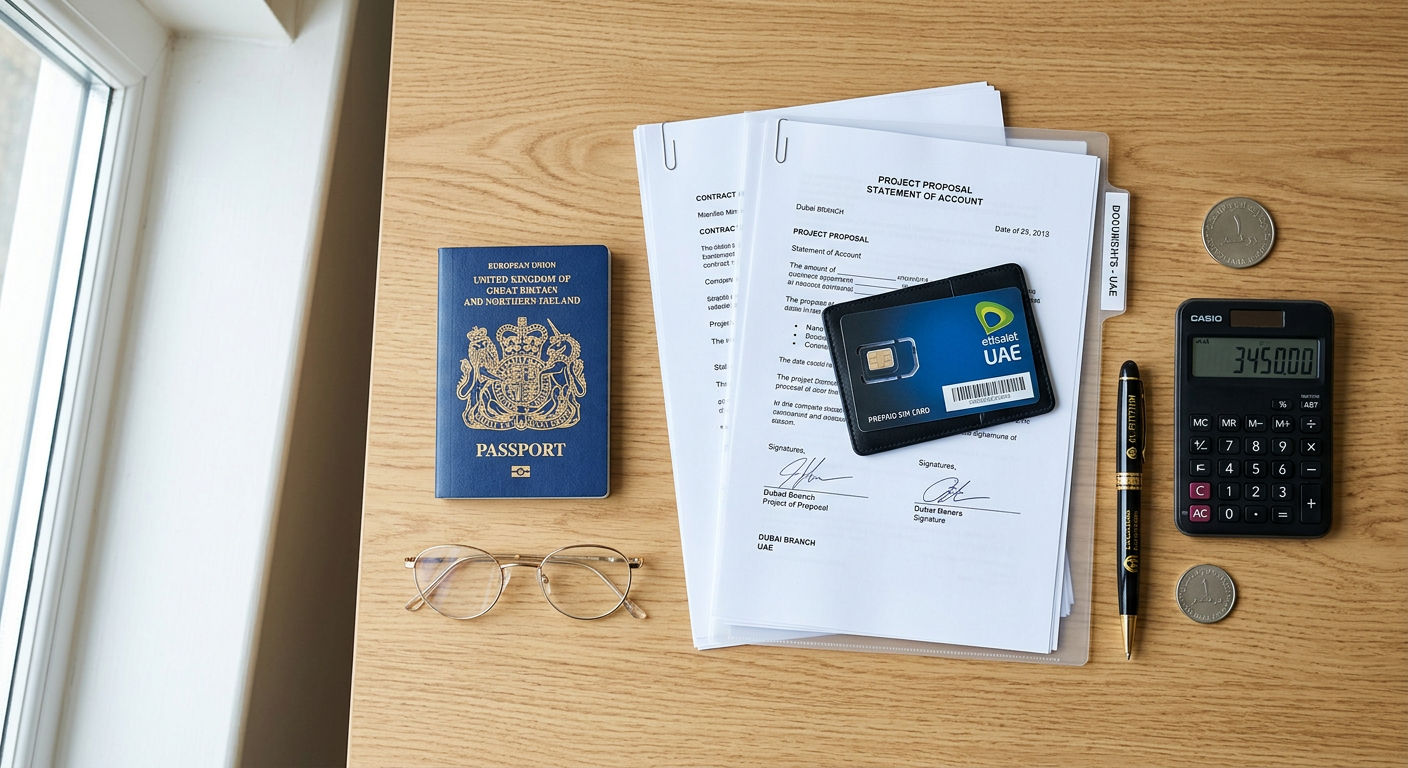
The list of documents required by any bank includes:
- Copies of passports of all shareholders and beneficial owners (notarised translation into English).
- Proof of address: utility bill, tenancy agreement, or bank statement from a bank in the country of residence.
- Bank statements for the last 6–12 months.
- Company incorporation documents: certificate of registration, memorandum, resolution on the appointment of director.
- A business plan or description of the company’s activities. The process requires detail: what you will trade, where the goods come from, who the client is.
Information on each application is checked against sanctions databases, reputational risks, and sources of capital. Whether you are dealing with Arab banks (Emirates NBD, ADCB) or international ones (HSBC, Standard Chartered), the procedure is similar, but minimum balance requirements differ.
Additional documents may be required in large numbers if the business falls into a regulated sector (real estate, cryptocurrency, arms trade).
Specifics for Non-Residents and Certain Categories
Non-residents are often intimidated by bureaucracy. Yes, it is difficult, but manageable. Unlike individuals, companies need to provide:
- Proof of source of capital (property sale certificates, dividends, salary).
- Counterparty due diligence: who you plan to work with.
- Stable financial standing of the founding company.
If you are from Russia, since 2022 many financial institutions have been acting cautiously. It is difficult for Russian citizens to open an account without local residence, but there are ways: through UAE resident partners or using intermediary services. Moscow is not an obstacle if the business is not linked to sanctioned goods.
The client is often asked to state the source of turnover. It is important to be ready to explain every large payment. The AML/CFT monitoring system in the UAE is one of the best, so a refusal can come even at the final stage.
Account Opening Process
Stages of opening an account in Dubai:
- Choosing a bank and type of services. Top options: Mashreq NeoBiz (for startups), RAKBANK (for small businesses), Emirates NBD (for large companies). Conditions vary: minimum deposit from 50,000 to 500,000 AED.
- Compiling the dossier. Full preparation takes 1–3 weeks.
- Submitting the application. Usually via an online form or through a manager.
- Interview. The individual (director) will have to answer questions about the business structure, risks, and sources of funds.
- Waiting for a decision. On average – one month, but can be faster (7–14 days) or longer (up to 3 months).
- Activating the account. Receiving a card, login, and system access.
The process differs depending on whether you open an account at a traditional branch or a digital one. Digital neobanks (Zand, Mashreq Neo) require a minimum of in-person meetings.
Make sure you have a local phone number and a physical address. Without these, your application will not be accepted.
Common Mistakes and Reasons for Refusal
The refusal rate in Dubai is high.
- Overly complex ownership structure. If shareholders are offshore companies in Seychelles and the beneficial owner is not disclosed, the bank will refuse.
- Data mismatch. The address on the statement does not match the one declared. Your address in the UAE must be confirmed by a tenancy agreement.
- Lack of business information. The activity must be clearly described. Words like “consulting” or “trading” without details are a red flag.
- Suspicion of the grey economy. Cash transactions without explanation.
- Outdated or incomplete documents. The passport must be valid. Visa status must be valid at the time of application.
The bank will contact you to confirm any unclear transaction. The work of the compliance department cannot be ignored.
Tax and Legal Nuances
The UAE is a low-tax jurisdiction. Corporate income tax is 0% for most businesses. In 2024, a 9% tax was introduced for corporations with profits above 375,000 AED. Transfers in dollars and other currencies are not subject to additional fees.
The company’s activities must correspond to its licence. If the bank discovers transactions that do not match the profile, the risk of account blocking increases dramatically. Under the service agreement, the bank is entitled to freeze funds without warning.
The shareholder or director must ensure that passports are valid. But passports alone are not enough – all copies must be notarised and apostilled. The UAE territories did not belong to the pan-European tax information exchange network (until 2024), but from 2025 onwards they are joining the CRS (Common Reporting Standard).
Success in opening an account in Dubai directly depends on business transparency and the quality of document preparation: banks require clear confirmation of the source of capital, a detailed business plan, and the applicant’s physical presence. The main difficulties for non-residents are offset by choosing between traditional branches and digital neobanks. Opening a corporate account in the UAE is achievable provided there is full financial transparency and a readiness to adapt to local rules.